
내일도 출근! (I’ll Go to Work Tomorrow!): The K-Drama About Office Life That Hits Differently in 2026
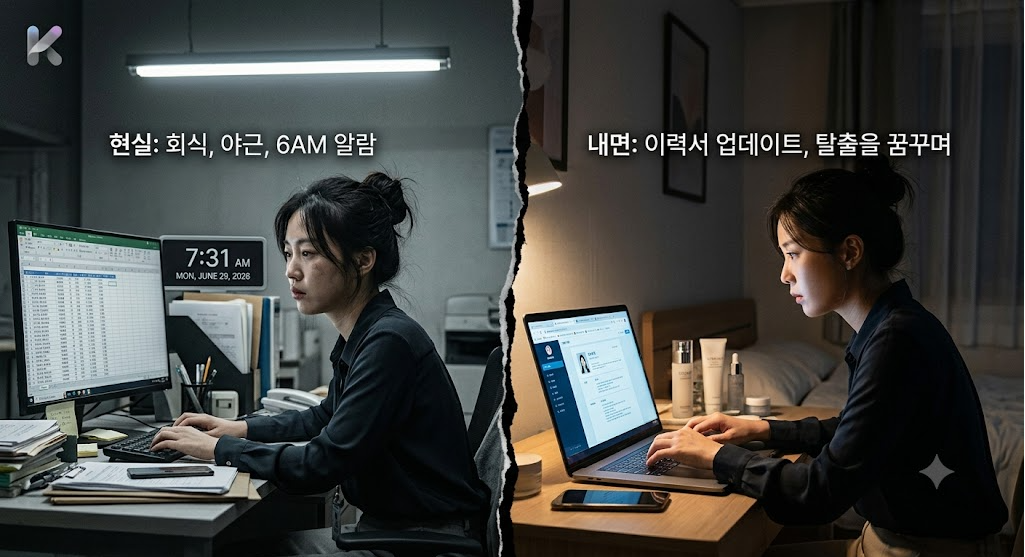
Every Monday, 3.7 million South Korean workers quietly update their résumés — not to leave, but just to feel like they could. The fluorescent hum of the office, the obligatory after-work hoesik, the alarm set for 6 AM again. What keeps people showing up, day after day, when the exit door feels so close?
It’s Sunday night. Your alarm is set, the week looms, and a familiar dread settles deep in your bones — almost too specific to articulate. Across a screen, somewhere in Seoul, a character in 내일도 출근! mirrors this exact crisis, albeit with a meticulous ten-step skincare routine and a coworker whose passive aggression could win awards.
Last updated: June 26, 2026 · Reviewed by Kloverwave Editorial
내일도 출근! (I’ll Go to Work Tomorrow!) is a Korean workplace drama that centers on salaried office workers navigating corporate hierarchies, suppressed ambition, and the psychological weight of showing up daily to a job that never quite fits. Western prestige television occasionally skirts this territory. 내일도 출근! parks itself right in the middle of it and refuses to move.
The Global Shift: Why 내일도 출근! Arrives at the Right Moment for Korean Office Dramas
Korean workplace dramas are not new. What has changed in 2026 is the critical context surrounding them. Western media reviewers are now placing the best of the genre alongside Severance and Industry — not as curiosities, but as peers. That repositioning matters.
The tropes that once defined the genre have largely been retired. The bumbling intern who accidentally saves the company. The all-powerful chairman hiding a secret heir. Their replacements are messier and more honest: characters who are competent enough to survive, quietly fueled by ambition, occasionally petty, and frequently exhausted. 내일도 출근! belongs squarely to this newer wave.
The commercial foundation beneath that shift is substantial. The Korea Creative Content Agency’s Hallyu White Paper reported that Korean Wave content generated an estimated $25.7 billion in indirect export effects in 2022 alone. (Source: KCIA Hallyu White Paper 2022) The scale of Korean content exports has grown considerably in recent years — KOFIC data put Korean film exports alone at around $71.5 million in 2022, while the Korea Creative Content Agency has estimated total content exports at approximately $3.1 billion across all categories. (Source: KOFIC; Korea Creative Content Agency) These are not the numbers of a passing trend.
The audience driving those numbers has matured. Viewers who arrived via idol-centered school romances have grown older, entered workplaces, and started looking for stories that reflect what they find there. Squid Game, released on September 17, 2021, became Netflix’s most-watched series ever, accumulating over 1.65 billion viewing hours in its first 28 days — a figure Netflix announced during its Q3 2021 earnings report in October of that year. (Source: Netflix Q3 2021 Earnings Report, October 19, 2021) That moment did not create demand for Korean content — it revealed demand that already existed. As for the broader genre share, some industry analysts have reportedly estimated that Korean dramas now account for a significant majority of non-English scripted demand on major global platforms, though independently audited figures vary by platform and measurement period. (See: Parrot Analytics 2023, methodology notes apply)
The office setting itself gives writers a structural gift that travel romances and fantasy series cannot easily replicate: hierarchy with consequences. Korean corporate culture operates on a seniority system — sunbae and hoobae — where social and professional authority interlock in ways that have no clean Western equivalent. Your senior colleague’s approval shapes not just your project outcomes but your standing in every meeting, every lunch, every group chat. 내일도 출근! treats this system with precision. The series communicates how suffocating that invisible ranking feels — and, crucially, how absurd it becomes when pushed against ordinary human frailty.
[LINK: related post about best Korean workplace dramas to watch in 2026]
The Unvarnished Truth: What 내일도 출근! Nails About Work Life
This drama never romanticizes the grind. That choice is rarer than it sounds.
Many office narratives — American prestige dramas included — inadvertently glamorize overwork. They dress exhaustion in expensive suits and frame late nights as evidence of passion. 내일도 출근! refuses that framing. The fluorescent lights in its office do not flicker romantically. They just flicker — harsh, cheap, slightly too bright — because that is what fluorescent lights actually do.
The drama’s central character, a mid-level employee in her early thirties, is neither a lovable underdog nor a hidden genius waiting to be discovered. She is good at parts of her job and mediocre at others. She remembers birthdays strategically. She says the right thing in team meetings and the wrong thing to her manager’s face. The series tracks her daily negotiations between self-preservation and self-respect without resolving them neatly, because they do not resolve neatly.
Several scenes stand out for their specificity. One extended sequence depicts the unspoken calculus of who speaks first in a team debrief when the project has failed — not who apologizes, but who opens their mouth and in what order. No score swells. No dramatic confrontation follows. The scene ends, and everyone returns to their desks. It is one of the most accurate depictions of Korean office culture in recent drama memory precisely because nothing is explained or exaggerated.
The drama also engages directly with the 조용한 사직 — quiet quitting — discourse that accelerated in Korean public conversation following the pandemic. One supporting character, a talented junior employee, has mentally checked out but performs engagement with technical perfection. He attends every workshop. He submits every report on time. He has simply stopped caring whether any of it matters. The show neither condemns nor celebrates his position. It observes it, which is the more honest choice.
Romantic subplots exist but do not dominate. When they surface, they are constrained by the same professional calculus that governs everything else — who holds what rank, what a relationship would cost in visibility, whether the timing is survivable. Even attraction, here, runs through the hierarchy.
The pacing in the early episodes is deliberately slow. Viewers expecting the propulsive momentum of a thriller-adjacent office drama like Misaeng may find the first two episodes resistant. Persist. The series is accumulative. By episode four, the weight of small moments compounds into something that is genuinely difficult to shake.
Why 내일도 출근! Resonates Beyond Korea
The youth unemployment rate in South Korea has remained a persistent pressure point in recent years, with Statistics Korea reporting figures that have kept the N포 세대 — the generation giving up on milestones — in active public discourse. (Source: Statistics Korea Labour Force Survey 2024) 내일도 출근! drops into that context not as escapism but as acknowledgment.
That dynamic travels. Overwork culture, credential anxiety, the particular exhaustion of performing enthusiasm for a job that does not love you back — these are not exclusively Korean conditions. The specific cultural textures are Korean, and the drama does not sand them down for international accessibility. But the underlying emotional register is recognizable across borders, which is why the series has found audiences well outside its domestic market.
Subtitles help. The fan translation community around this series has been notably careful about preserving workplace-specific vocabulary — 야근 (overtime), 보고 (formal reporting upward), 회식 (mandatory after-work drinking) — rather than flattening these terms into generic English equivalents. That fidelity matters. It is the difference between a drama that travels and one that is merely exported.
Conclusion
내일도 출근! does not promise that work gets better. It does not suggest that the right attitude or the right mentor will resolve the fundamental friction between institutional demands and individual integrity. What it offers instead is recognition — the particular relief of seeing something true about your daily life rendered on screen without sentimentality or solution.
That is not a small thing. For a genre that spent years obscuring the actual texture of office life behind romantic fantasy and wish-fulfillment plots, a drama willing to sit with the honest weight of Monday morning is, in its own quiet way, a significant one.
Set your alarm. The drama will still be there when you get home.
Which scene or character in 내일도 출근! hit closest to home for you — and did it make Monday feel any more bearable, or just more honestly unbearable?
Frequently Asked Questions
Is 내일도 출근! based on a webtoon or novel?
The drama is an original screenplay. It was not adapted from a pre-existing webtoon or literary source, which gives its narrative structure more room to develop character arcs without the pressure of fan expectations tied to source material.
How many episodes does 내일도 출근! have?
The series runs sixteen episodes at approximately sixty to seventy minutes each. The pacing rewards viewers who stay through the slower opening stretch.
Do I need to understand Korean corporate culture to enjoy it?
No. The drama contextualizes its cultural specifics well enough that newcomers can follow without prior knowledge. Returning viewers with some familiarity with Korean workplace dynamics will catch additional layers, but they are not required for emotional engagement.
How does it compare to Misaeng?
Misaeng operates at higher dramatic stakes and moves faster. 내일도 출근! is quieter and more interior — less interested in whether its characters succeed and more interested in what success would actually cost them. Both are worth watching. They are not in competition.
Where can I watch 내일도 출근! with English subtitles?
Availability varies by region. Check major streaming platforms carrying Korean content for your territory. Fan subtitles have circulated through dedicated communities for regions where official distribution remains limited.
Sources & References
- KCIA Hallyu White Paper 2022 — Korea Creative Content Agency
- KOFIC Annual Report 2022 — Korean Film Council
- Netflix Q3 2021 Earnings Report (October 19, 2021)
- Parrot Analytics 2023 (methodology notes: demand measurement methodology varies; figures should be treated as directional estimates)
- Statistics Korea Labour Force Survey 2024
Expert Analysis: “The surge in workplace-centered K-dramas reflects a broader cultural recalibration post-pandemic, where Korean audiences are actively processing anxieties around job insecurity, hierarchical pressure, and the blurred boundaries of digital-era labor. What distinguishes I’ll Go to Work Tomorrow! is its timing — dropping amid record youth unemployment and the ‘조용한 사직’ quiet quitting discourse, it functions less as escapism and more as collective catharsis.”
— Kloverwave K-Content Market Analyst
[kw_author_box name=”Kloverwave Editorial Team” title=”K-Culture Media Analysts” bio=”Kloverwave covers the Korean Wave (Hallyu) for global fans — delivering in-depth analysis on K-pop, K-drama, K-food, K-beauty, and Korean lifestyle trends. Our editorial team fact-checks all statistics and sources before publication.” site=”kloverwave.com” updated=”2026-06-26″]
[META: 내일도 출근! review: why this Korean workplace drama is one of 2026’s most honest portrayals of office life, corporate hierarchy, and quiet exhaustion.]
Related Posts
- Suddenly K-Drama: Why Global Gen Z Can’t Stop Watching
- Unpacking *Cham Gyoyuk* (참교육): The Brutal Korean School Webtoon That’s Going Global
- K-Content in 2025: Why Korean Film, Drama, and Music Are Rewriting the Rules